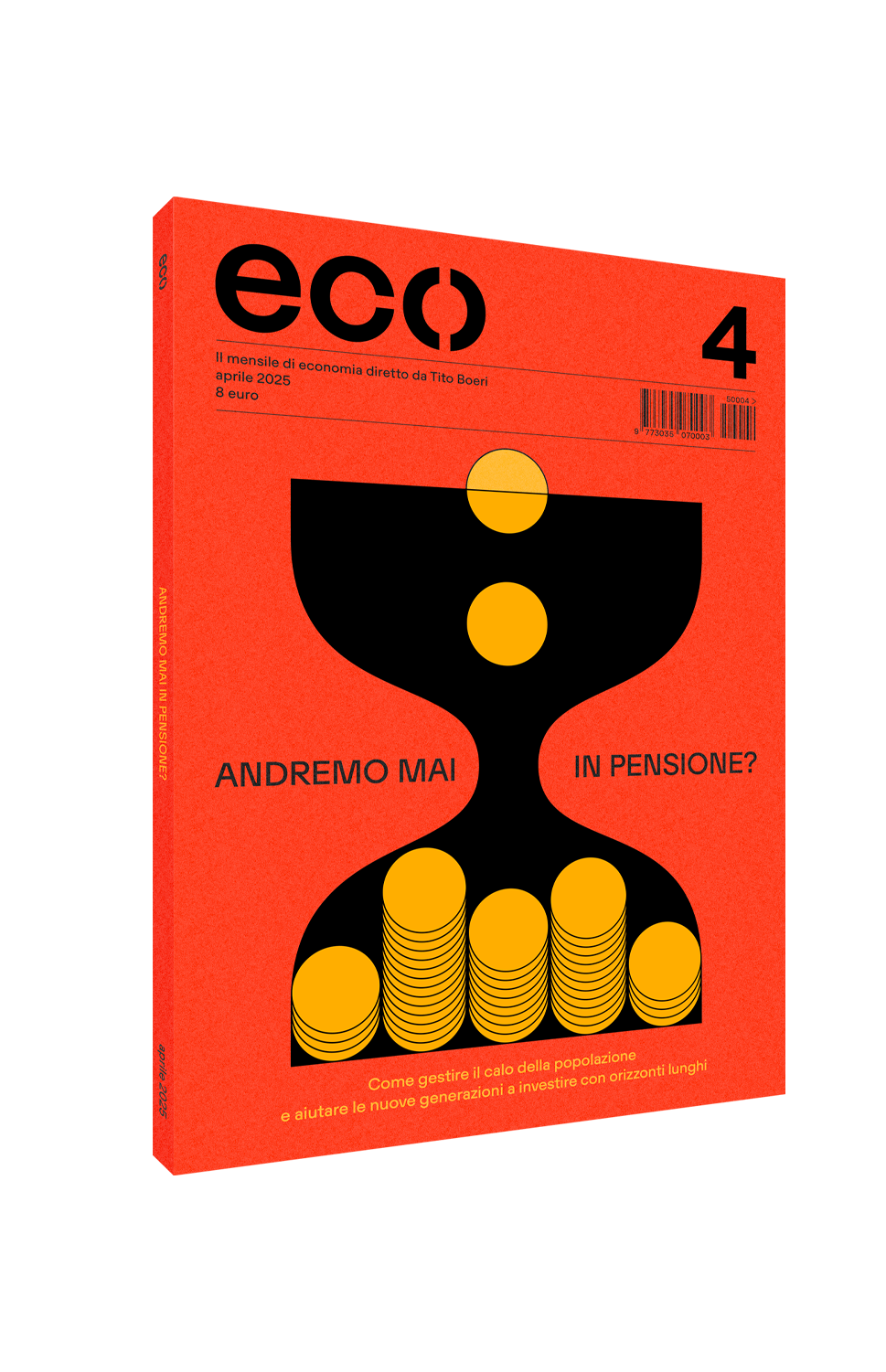
How can we ensure that young people will have adequate pensions? It’s good that they start thinking now about long-term investing. It’s essential that governments stop continuously changing the rules, relieve families from the burden of caring for non-self-sufficient individuals, aim to curb the decline in the number of contributors, and provide oversight for all forms of pension schemes. Meanwhile, eco turns one year old, and it’s time to introduce a few changes.
Will young people ever receive a pension? It’s a question I’m asked at every public event. It seems to worry parents more than the young people at the start of their careers. The youth appear resigned to receiving smaller pensions, though that future still feels far off. Nevertheless, it would be wise for them to start thinking about it now: to seek jobs that include pension contributions and to ensure their employers actually pay their full share. Under the contribution-based system, the payments made early in one’s career are the most valuable for pension calculations—exactly the opposite of the previous earnings-based system, which provided pensions for their parents. Back then, it was mainly the salaries and contributions from the final years of work that counted.
But let’s return to the question that worries so many families. It’s poorly framed. The issue isn’t whether today’s youth will get a pension, but how generous that pension will be. And the answer depends on personal decisions they can make—but also on external factors that political choices can influence for better or worse. That’s why it’s important for today’s young people (and their concerned parents) to start thinking now about their post-work years and to put the choices that affect their children’s futures at the center of public debate.
What Young People Can Do to Protect Their Future
As we show in this issue of eco, tomorrow’s public pensions (those paid out by the INPS, to be clear) will be less generous than today’s. Not so much because people will retire later—this will be offset by receiving benefits for a longer time. Rather, pensions will no longer guarantee the same standard of living that individuals enjoyed while working. Until now, pensions have typically provided about 80% of the final salary at the end of one’s career, and the rest could be made up through small jobs or other income, like rental properties. Future pensions are likely to offer around 60% of the last salary—a substantial drop in living standards compared to working life.
We use the word “likely” because, unlike in the past, future pension amounts are not guaranteed as they were under the earnings-based system. They won’t depend on the number of years worked, but on how the contributions paid throughout one’s working life perform over time. And this performance will largely depend on how the Italian economy fares in the coming years. If we continue to grow at very low rates, as a stagnant economy, pensions will become even less generous. The projections provided by the INPS website (unfortunately not yet available for all job categories) give a sense of what your pension might look like based on your career and economic trends—assuming, of course, that the rules determining these amounts don’t change again before then.
Given this great uncertainty and the declining generosity of future pensions, it’s essential to think now about post-retirement income. This means long-term investing—setting aside resources that will generate returns far in the future—and diversifying investments to reduce overall risk. If one investment fails, another may succeed. As we’ve seen, the risk tied to mandatory INPS contributions is linked to the performance of the Italian economy (they are invested entirely within our country) and to the risk that future governments continue to change pension rules as they’ve done almost every year over the past thirty years. All this means setting up accumulation plans in pension funds that are not solely invested in the Italian economy—or in any case, making long-term investments while following the general principles outlined in our “Understanding Finance” section.
What Governments Can Do to Protect Young People
There are many things governments can do to make the pension future of young people more promising and less uncertain.
The first, already mentioned, is to stop constantly changing the rules to benefit specific voter groups. Some parties in the current governing coalition want to block the automatic adjustment of the retirement age to life expectancy—an adjustment introduced by the 1995 reform. Doing this would hurt young people because it would endanger their future pensions. The automatic adjustment of retirement age is meant to align the extension of our lifespans—one of the great achievements of recent times—with the sustainability of our pension system. As we show by analyzing pension spending over the next 50 years, increased longevity is not a problem for our system under current rules. It’s something to celebrate—especially if we can make those longer lives healthy and enjoyable.
This leads us to the second key action: planning now how to provide long-term care for non-self-sufficient individuals without placing the burden solely on their families. Young people’s careers—especially those of young women—are currently hindered by family responsibilities that make them irregular and less profitable, as we discussed extensively in the previous issue of eco. Irregular careers and lost income significantly affect future pensions. Improving care for the elderly, as we suggest in the following pages, thus provides a double benefit: it increases the well-being of those who can no longer care for themselves and frees up time, energy, and intellectual and human resources for those in their prime working years.
The third essential action governments can take is to slow the decline in the number of contributors—and possibly even reduce social security contribution rates, rather than increase them, as attempted in the latest budget law, which aims to raise the contributions paid annually by current workers to the INPS. The drop in the number of contributors is the real time bomb threatening the future of our pension system. We must intervene by promoting greater female participation in the workforce, easing the school-to-work transition, slowing emigration—especially brain drain—and managing immigration. These are all topics we’ve addressed in previous issues of eco. Measures like these would also help raise fertility rates, since working women today tend to have more children—as do the educated and talented young Italians we lose every year and the first- and second-generation immigrants. Workers already contribute nearly 40% of their pay to mandatory pension schemes (including severance pay allocations). This is the highest level among OECD countries. Further increasing this burden would prevent young people from doing what we mentioned above: investing long term and diversifying their investments to lower overall risk and secure a decent pension.
The fourth action is to provide oversight and regulation for all pension schemes. Today, as we document, there’s a segment of the pension system that is self-regulated and not subject to public scrutiny regarding its investment choices: the professional pension funds. This is a highly heterogeneous system, with virtuous entities alongside poorly managed ones that neglect long-term sustainability. The main issue with these funds is their narrow contributor base. If the professions they serve decline due to technological shocks, changing public preferences, or other factors, the funds collapse. That’s what happened with INPGI, the journalists’ fund, which was later bailed out by the INPS—meaning by all of us—after poor asset management was compounded by the crisis in the journalism sector. For this reason, these funds are intrinsically fragile. Since they receive mandatory contributions, they cannot be exempt from financial investment regulation. It would also be wise to consolidate pension funds and promote their development. This would help expand our capital market, thus supporting growth and boosting returns on first-pillar contributions—those managed by INPS.
One Year with eco
Like all of us, eco is getting older. With this issue, we turn one. It’s been a year full of satisfaction and learning, and we want to build on those lessons. Thanks to your feedback, starting with this issue we’re introducing several changes. First is the graphic redesign. Eco is not a news magazine. It’s a journal that features analyses meant to remain relevant over time. Each issue is like a book. That’s why we’ve chosen a format suitable for keeping eco on your bookshelf at home.
We’ve also invested more in charts—the economists’ visuals—rich with data and information. And we’ve made reading easier for those in a hurry, with article summaries at the beginning and an improved digital reading experience. This redesign, with higher-quality formatting for both print and digital editions, comes with costs. For that reason, regrettably, we must raise the price of a single issue at newsstands to €8.
There are also editorial changes. We’ve created a new Letters to the Editor section to feature your correspondence. We’re launching a new column, “The Welfare State,” where we’ll review, one by one, the benefits that a welfare state—like INPS—provides to citizens. The goal is to help everyone understand what benefits they’re entitled to (many are unaware) and to assess their usefulness (or lack thereof). Lastly, we’ve decided to consistently cover sports—not just as a business, but also as a field where it’s easy to measure individual and team performance and productivity.
We sincerely hope you enjoy these innovations. Let us know what you think.
P.S. The next issue will be on newsstands May 17 and will focus on European defense.