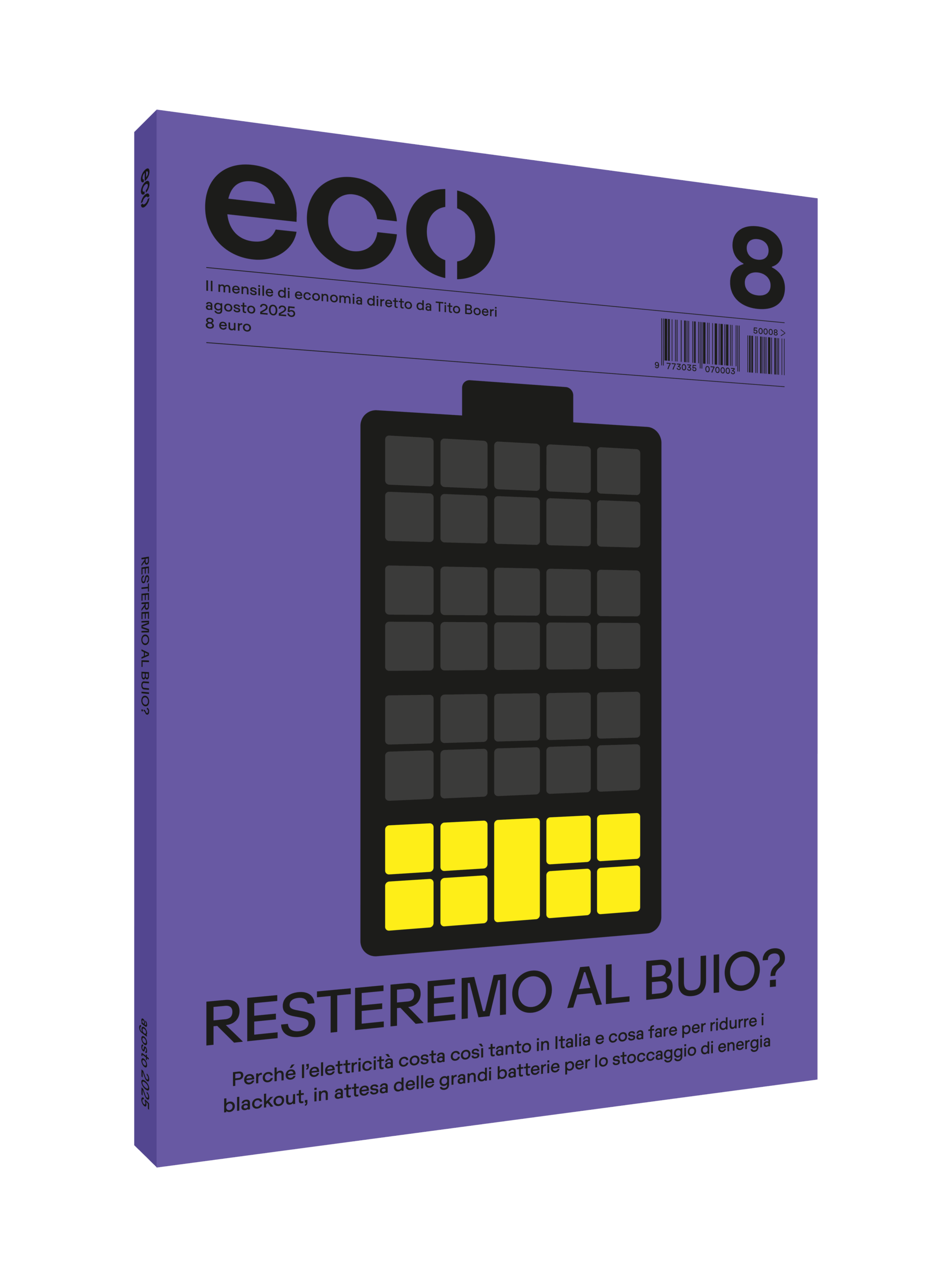
The fear of being left in the dark no longer belongs only to children. It is a real risk looming over all of us, as shown by the long and short, widespread and localized blackouts that have occurred across Europe — and their long trail of inconvenience and damage. To reduce this risk, it is crucial to diversify energy sources, because this makes it possible to compensate for potential shortages in one by increasing the use of another. Greater interconnection among Europe’s power grids is also essential. Energy choices and climate goals are closely linked: it would be a mistake for us Europeans to abandon the decarbonization targets we have set for ourselves in order to follow the bad example of the United States under the Trump administration.
Many people of my generation probably took their first dance steps to Senza luce, the Italian version of Procol Harum’s A Whiter Shade of Pale. We danced to it under dim lights — not in total darkness. There was electricity, of course: the vinyl records were spinning on the turntable. Today’s young people may have different musical tastes, but whether they dance slow songs or not, they are far more dependent on electricity than we ever were — and face a much greater risk of truly and lastingly being left without light.
Small Blackouts That Don’t Make the News — but Cause Real Damage
We’re not referring only to the large-scale blackouts that have made headlines around the world, such as the one that plunged the entire Iberian Peninsula into darkness on April 28, 2025; or the one that, at the end of June this year, turned off the lights of the Eiffel Tower and forced the closure of 1,200 schools in Paris; or again, the one that, in Italy, during the night between September 27 and 28, 2003, brought everything to a standstill — elevators, streetlights, traffic lights, even hospitals and health facilities without emergency generators.
Rather, we are talking about the thousands of local blackouts that occur every year, affecting only a small town or a city neighborhood. They go unreported, not even called “blackouts” but more prosaically “unplanned outages.” Yet they endanger human lives and cause major losses for those affected. When they happen, we realize just how dependent we are on the electrical grid. It’s not just the lights that go out, or the air conditioners and electric boilers that stop working, or the refrigerators and freezers that turn into containers of spoiled food — it’s also the Wi-Fi systems and local phone networks that go down, cutting us off from the rest of the world. These blackouts bring entire communities to their knees. It’s no coincidence that in the ongoing war on Europe’s borders, power plants are among the primary and recurring targets of missiles and drones.
According to data collected by the European Network of Transmission System Operators for Electricity (ENTSO-E), events that put the high-voltage grid under stress have increased by 60% in the past ten years, partly due to extreme weather events. Their frequency and duration could be greatly reduced through a more efficient grid and a proper diversification of energy sources. Unfortunately, that is not the case with Italy’s vulnerable, costly, and congested power network, as we document in this issue of eco.
Vulnerability, European Integration, and Diversification
Beware of the absolute partisans of a single energy source! Too often we hear extreme positions — from those who see nuclear power as our salvation, to those who bet everything on hydrogen, to those who envision a world powered solely by renewables, to those who long for a return to fossil fuels. The truth is that every energy source has its advantages and its risks — and fortunately, these risks are not correlated. For example, droughts that dry up rivers and reservoirs undermine hydropower production, but not nuclear power. A lack of wind hurts wind energy, but not solar. If one refuses to diversify, the only alternative is to operate with an excess of production capacity — maintaining more plants than strictly necessary in order to offset potential drops in generation from any single source. But running multiple idle plants just in case is extremely costly. And the examples could go on.
For all these reasons, the best course of action is to diversify electricity generation, so that if a risk arises that jeopardizes one source, another can at least partially make up the shortfall. There are also “positive risks,” such as technological innovations that make a source of energy cheaper, or advances in large-scale battery storage. No one can predict today what the future of technological progress in energy will bring. To protect ourselves against negative risks and take advantage of positive ones, it is essential to diversify energy sources. Diversification — a principle we have often discussed in the Understanding Finance column — applies equally well here.
The other strategy for reducing vulnerability is consistent with another principle that has often found space in these pages — so much so that it inspired the title of a column (Sovereign in Europe). To shorten the duration of blackouts, it is crucial to be able, in an emergency, to quickly access energy produced in other countries. If Spain and Portugal had been able to import larger amounts of electricity from France on April 28, the damage caused by the blackout would have been far less severe. The integration of power grids is a fundamental part of the broader process of European integration.
But Who Decides — and for Whom?
Energy interventions involve immediate costs and benefits that materialize only over time — often far beyond the lifespan of a single government. The same goes for their environmental impact, which extends well beyond the geographic borders of the country implementing the policies.
This is why supranational authorities, such as the European Commission, play a key role in setting long-term targets to guide national governments’ decisions. This is the purpose of the ambitious goals we have set at the EU level to reconcile energy efficiency with environmental sustainability: achieving net-zero emissions of CO₂ and other greenhouse gases by 2050, with interim targets of a 55% reduction by 2030 and 90% by 2040.
There are two fundamental challenges with this European strategy.
The first is that it is difficult to constrain the actions of future governments. The sovereignty rhetoric preached by populist leaders thrives on rebellion — on hostility toward the rules established at the European level by institutions often unelected by citizens. It is therefore advisable to include clauses that allow new governments wishing to revise the plans signed by their predecessors to do so — but only at significant economic and political cost. For instance, if a future government decided not to comply with targets previously agreed at the European level, it could negotiate a change with the other EU members and compensate those states that would then bear the extra effort needed to reach the common target, possibly using the European Emissions Trading System. This mechanism allows countries and national operators to buy and sell emission allowances. What matters is that the system remain transparent and easily understandable to citizens.
The second problem is even more complex. Even if Europe were to meet the ambitious goals it has set for itself, if the other major global players — starting with China and the United States — do not do the same, the benefits for which so many sacrifices have been made would not materialize. In other words, there is an absolute need for multilateralism — for coordination among blocs and a shared pursuit of the global common good in energy policy. Some argue that, given what is happening in the United States, Europe should scale back its own energy ambitions, since they will be rendered meaningless by America’s de facto abandonment of environmental protection. This is a convenient argument, allowing, for example, prominent members of the Italian government to blame European bureaucracy rather than call out the U.S. about-faces. We do not agree. Europe is a major global actor. It can manage both the opportunities and the risks posed by China’s near-monopoly in the solar industry — deciding whether to fully exploit lower costs or protect domestic production. No single EU country has this decision-making power on its own. Europe can also serve as a point of reference for many other nations, as we have noted in previous issues of eco. It is a model of multilateralism for the entire world — including future U.S. administrations. The success of the Union in pursuing its ambitious energy and environmental goals will also determine the future of multilateralism — humanity’s true hope of salvation.
P.S. The next issue of eco will be on newsstands on September 20 and will focus on the war economy.
P.P.S. Those who blatantly violate the principle of diversification are, surprisingly, those who should treat it as their gospel. We are referring to the pension funds of commercial agents and representatives, doctors, and lawyers who have concentrated their investments in Mediobanca — probably to serve a power agenda. It is serious that the media remain silent about this small-scale financial maneuvering and the risks it poses to the savings of thousands of professionals. That is not the case with eco.