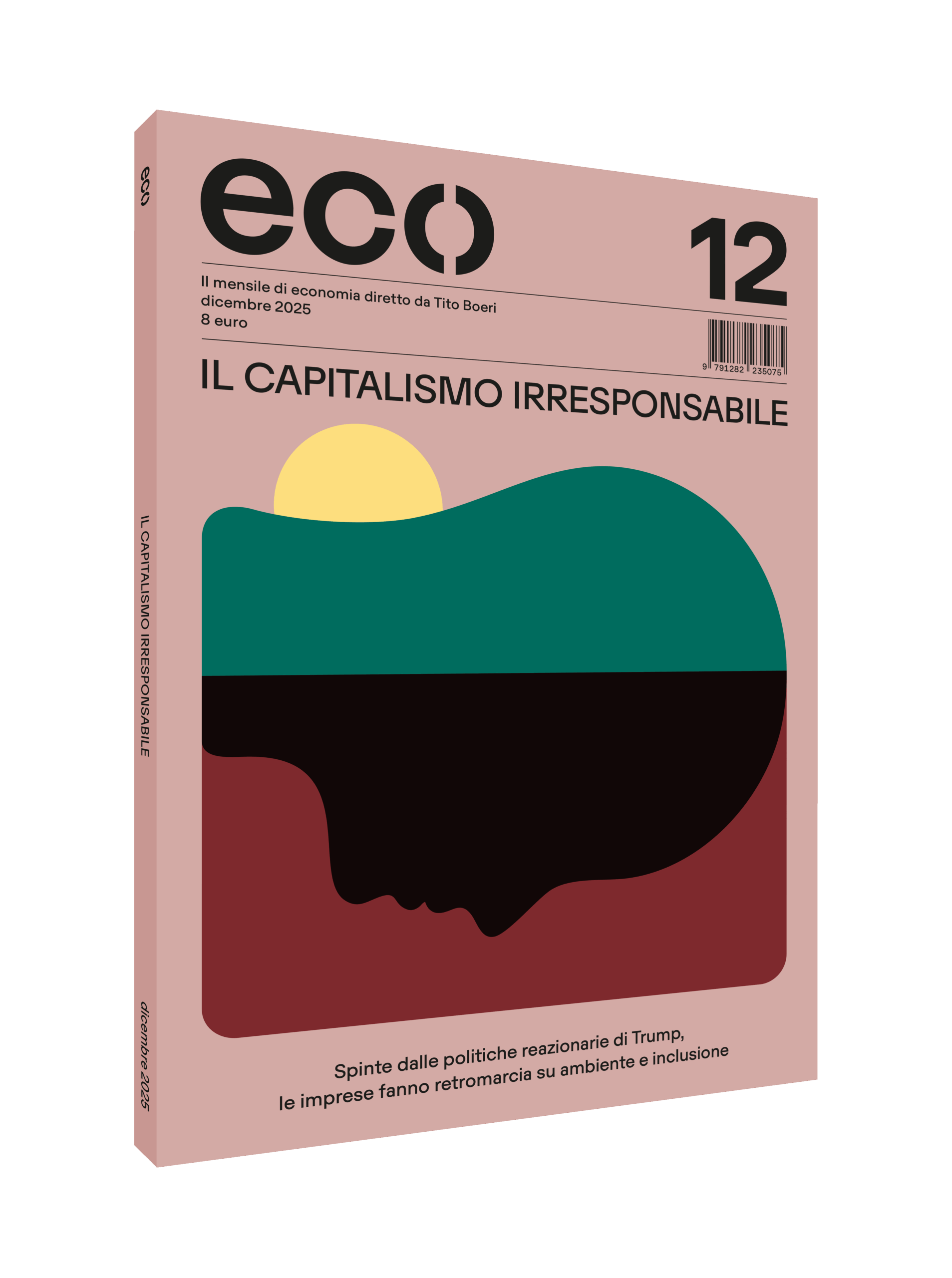
It took only four years for ESG to fall out of fashion—that is, the attempt to give capitalism a new face by encouraging companies to take responsibility for interests broader than those of their shareholders and to reconcile morality, environmental and social sustainability, and profits. Many mistakes facilitated the offensive against ESG launched by the new US administration. Yet the reasons underlying ESG commitments are still all there, from global warming to the lack of ethics in the behavior of many companies. In this issue, we offer various suggestions for relaunching corporate environmental and social engagement on more solid foundations.
Over the past four years, investments in companies that comply with environmental, social, and good governance criteria—summarized by the acronym ESG (Environmental, Social, Governance)—have fallen out of favor. In 2019, the Business Roundtable (an association of the CEOs of the largest US corporations) published a “Statement on the Purpose of a Corporation,” signed by more than two hundred CEOs, redefining corporate objectives to include the “creation of long-term value for all stakeholders,” emphasizing the importance of “serving customers, employees, suppliers, and communities” rather than merely creating value for shareholders. ESG commitments seemed destined to revolutionize corporate strategies, driven above all by the urgency of environmental issues to take responsibility for broader interests than those of shareholders and to reconcile morality, social engagement, and profits. These commitments appeared capable of changing the face of capitalism, making companies accountable to citizens for the legitimacy of their conduct and their ability to provide opportunities to vulnerable or underrepresented groups.
From Responsible to Irresponsible Capitalism
The initial enthusiasm for ESG has largely dissipated. We have moved from celebrating corporate social responsibility to denying the very problems companies were supposed to address, effectively granting a free pass to those that are environmentally and socially irresponsible. Today, behind the ESG acronym lies the perception of countless Errors and a Generalized Skepticism—not only in politics, but also in markets and public opinion.
In this issue of eco, we seek to understand the reasons for this abrupt reversal, convinced that the lessons to be learned from this experience can help lay more solid foundations for any future attempt to encourage companies to account for the moral, social, and environmental dimensions of their activities before consumers and the public at large. But let us begin by examining what has happened over the past four years, as many may have missed it.
A Widespread Retreat
The numbers speak for themselves. Global net capital flows into ESG funds—investment funds that select companies and other assets also on the basis of environmental and social sustainability criteria—grew sharply until 2021, exceeding 600 billion dollars, but began to decline rapidly in 2022 and 2023, falling to just 32 billion in 2024. In 2025, for the first time since 2018, ESG funds recorded net disinvestment: –57.5 billion dollars (see also this month’s chart). This is a historic reversal, due to a combination of factors: the war in Ukraine, which brought energy security back to the forefront regardless of its source; the growing politicization of climate policies; and the wave of “executive orders” issued by the new US administration in recent months, which have scaled back mandates and requirements related to ESG and DEI (Diversity, Equity, and Inclusion) policies aimed at fostering the inclusion of underrepresented groups. All of this has increased contractual uncertainty and the costs required for companies to comply with ESG standards, making long-term commitments to social and environmental goals less credible.
Corporate decisions have followed the same trajectory. In 2022, more than 60 environmental and social resolutions were approved by majority shareholder votes. By 2025, that number had fallen to five. A drastic decline reflecting fatigue, mistrust, and a growing question: does ESG really create value for companies?
Public opinion has also shifted profoundly. In the United States, the share of citizens convinced that the government is “doing too much” for the environment has nearly tripled compared to the 1990s, while those who believe it is doing “too little” have fallen to their lowest level in ten years. Sustainability, in short, is no longer a bipartisan issue, and ESG objectives have lost appeal on all fronts: political, corporate governance, and public opinion.
The Return of Environmental Denialism
This retreat is fueled by what we might call the “Great Green Denial.” A post-truth phase has opened in the climate debate, in which scientific facts no longer matter. Opinion pieces published even in newspapers such as The Wall Street Journal suggest that climate science is not real science; Donald Trump tweets celebrating alleged victories against “climate change hoaxes”; articles deny that CO₂ emissions affect global warming.
All this is happening while the climate emergency is becoming increasingly evident. The year 2024 was the hottest ever recorded, with global temperatures more than 1.5°C above pre-industrial levels. Sea levels are rising at twice the speed of thirty years ago. In Europe, more than 60,000 deaths linked to heat waves were recorded last summer, and worldwide economic losses from natural disasters exceed 300 billion dollars per year. Scientific data are unequivocal. Estimates of the cost of inaction converge in telling us that delaying the adoption of sustainable behavior simply means paying a higher price. Like a cyclist who loses the wheel of a teammate, the later one tries to close the gap, the more effort will be required.
Denialism helps create fertile ground for inaction, and when truth becomes negotiable, markets lose their compass as well.
Why ESG Has Lost Credibility
What explains the retreat of ESG? We identify five main reasons for the fall of these principles from grace.
1. Conflicts Among Investors
ESG commitments have primarily represented an investment in corporate image. However, as we document, the reputational benefits of a sustainable approach are not evenly distributed among shareholders, while the costs, in terms of forgone profits, often are.
2. Conceptual Confusion
Under the ESG label coexist different objectives—financial returns, ethical values, long-term resilience, environmental protection, social inclusion—that do not always align perfectly. Treating them as a single whole was a mistake.
3. Inconsistent Ratings
ESG rating agencies often disagree even on the sustainability profile of the same company. There are cases in which a firm is considered “cutting-edge” by one evaluator and “non-compliant” by another. The assessments offered by the three main ESG rating agencies (Asset4, Sustainalytics, and MSCI) are inconsistent with one another, with correlations close to zero. For investors, rather than providing a reference system, these ratings offer a labyrinth that is difficult to navigate.
4. The Taboo of Trade-offs
For years, the narrative was that “doing well means doing good,” implying that there was no conflict between maximizing profits and pursuing social and environmental goals. In reality, this is often not the case. Being responsible entails costs. Denying that morally inspired responsible behavior can reduce corporate profits has undermined the credibility of ESG, making it appear more like a marketing exercise than a choice based on rigorous analysis of risks and impacts. Paradoxically, this has devalued social commitment by turning it into a tool for achieving higher profits. Many shareholders would have been willing to make sacrifices in the name of moral principles, but not in the name of a presumed economic advantage for the company.
5. The Risk of Anti-competitive Behavior
Many ESG funds are managed by large asset managers (BlackRock, Vanguard) with cross-shareholdings. This raises questions about (at least potential) implicit coordination and possible anti-competitive effects disguised as ESG objectives.
Rebuilding ESG on Solid Foundations
ESG has tried to fill the void left by politics, with governments unable to coordinate in managing global resources such as the environment, or doing too little to give voice to underrepresented groups. Companies, especially large ones, often wield power greater than that of governments and can do much to address environmental problems and promote equal opportunities. It is also important that corporate management be accountable to shareholders not only for the profits achieved, but also for how they are achieved.
How, then, can we preserve what is valuable in ESG and restore corporate accountability? In this issue of eco, we offer many suggestions. Let us review the main ones.
It is advisable to separate E, S, and G. These are distinct areas, with different objectives and tools. Treating them as a single goal based on a single indicator creates confusion.
Measurement of social and environmental commitment must be standardized. The new standards of the International Sustainability Standards Board (ISSB) represent an important step toward common criteria, but coordinated efforts are needed for broad and consistent adoption.
We must be honest about trade-offs. Sustainability does not always maximize returns. ESG responds to moral principles, which shareholders may value even when they entail lower profits. It can be a tool to correct market failures and shortcomings in public policy, not merely a competitive lever.
The role of associations that coordinate small shareholders should be strengthened. Groups such as “Follow This” (an association that organizes small shareholders to bring environmental resolutions to shareholder meetings) have shown that coordinated shareholders—even with small stakes—can influence energy giants.
It is also beneficial not to rely solely on institutional investors, such as pension funds, which sometimes follow power-based rather than sustainability-based logic. Increasing small-shareholder democracy is important. Randomly selected shareholder assemblies, as proposed by Oliver Hart and Luigi Zingales (see his interview), can promote this process.
At a time when companies are increasingly struggling to find workers due to demographic decline, job seekers should be encouraged to ask potential employers not only about job quality (management style, relationships with colleagues, opportunities for remote work) but also about corporate culture and values.
Disinformation must be countered with transparency and data. Credibility can be rebuilt only through solid evidence and clear communication. The world is warming. The consequences are already before our eyes. Giving up on integrating sustainability and finance is not an option.
Starting again, this time on more solid and transparent foundations, is the only possible path forward.
P.S. The next issue of eco, on newsstands from January 17, will focus on taxes.