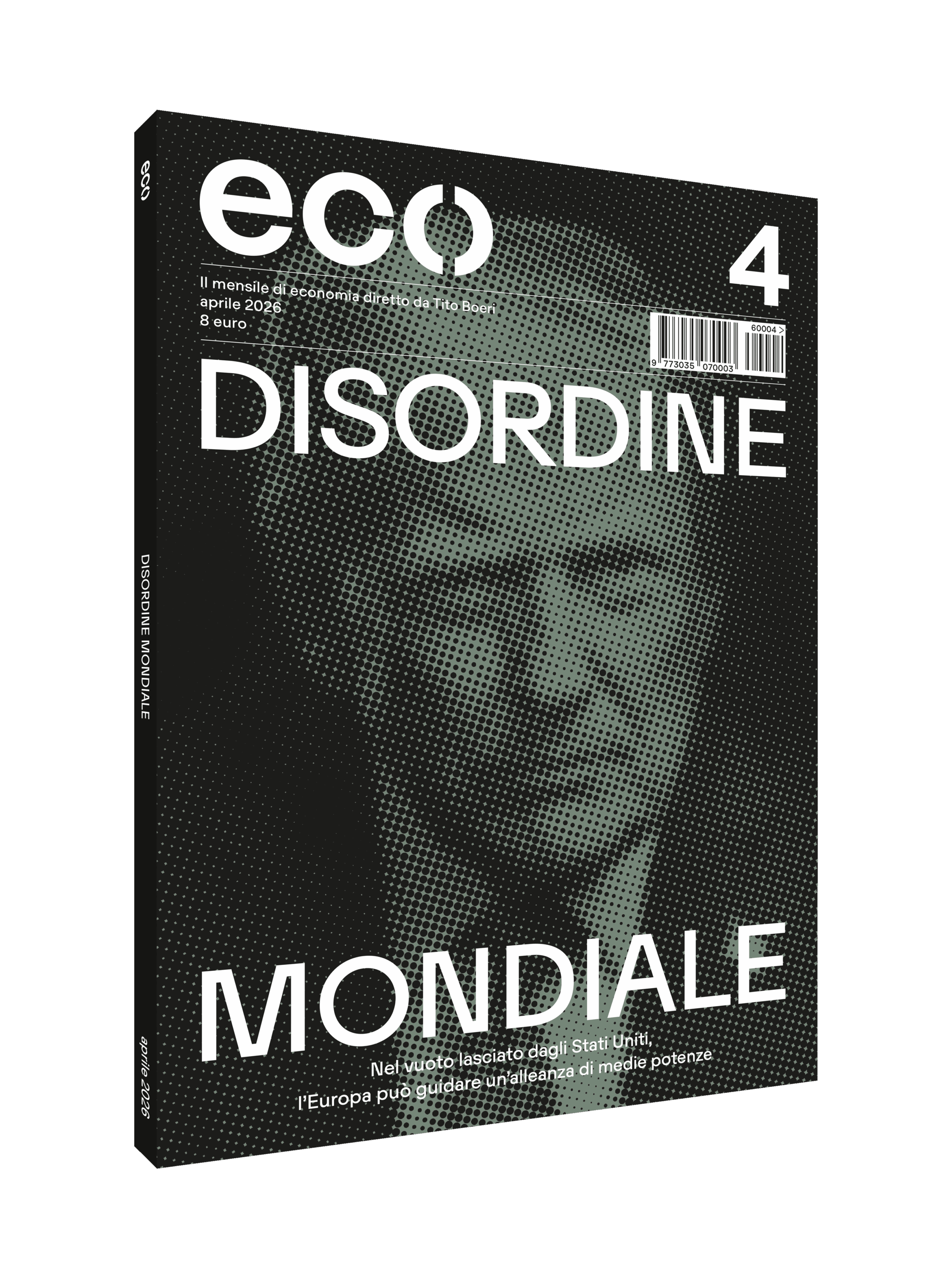
In just fifteen months, Trump has driven a deep wedge between the United States and its longstanding allies. At home, he has dismantled the system of checks and balances. Abroad, he has undermined the very foundations of international law and multilateral institutions. If they are to avoid ending up on the “imperial menu” invoked at Davos by the Canadian Prime Minister, middle powers have only one path forward: designing new balances of power and new forms of global coordination for managing common resources and international conflicts. Europe is the natural candidate to lead this process—not only because it remains the world’s only genuine example of multilateralism, but also because it has already demonstrated its ability to tackle major challenges through coordinated action. And at a time when security has once again become a priority, Europe’s welfare state may prove to be a strategic asset.
There is one image that perfectly encapsulates the legacy Donald Trump is leaving behind: the enormous pit dug into the White House gardens for the construction of what he called “the most beautiful ballroom in the world.” As expected, a judge halted the project, ruling that the President of the United States is not a pharaoh and therefore lacks the authority to demolish and replace entire sections of the presidential residence. In the judge’s words, Trump is merely the White House’s custodian, not its owner.
Construction has now been suspended, leaving behind a colossal hole that is likely to remain for quite some time. As is often the case with populist movements, they leave behind enormous holes but prove incapable of rebuilding.
During the first fifteen months of his second presidency, “The Donald” has dug a new Mariana Trench—this time in the Atlantic Ocean—by repeatedly lashing out at Europe, America’s historic ally. He has opened fissures even deeper than those created by global warming—which he continues to deny—in Greenland’s glaciers. He has undermined the already fragile architecture of international multilateral institutions by depriving them of essential resources, as this month’s chart illustrates. He has turned international law into Swiss cheese. Through executive orders, he has crippled the institutions of checks and balances that lie at the heart of democratic systems. And he has transformed the MAGA movement’s frustration over the end of the unipolar era—the period of uncontested U.S. dominance following the fall of the Berlin Wall—into blind aggression and improvised displays of military power.
Did Multilateralism Ever Really Exist?
This issue of eco echoes the speech delivered by Canadian Prime Minister Mark Carney at the Davos Forum. At its core was the acknowledgment that the liberal international order—a world governed by shared rules binding on everyone, from the weakest to the strongest—has come to an end. It was, indeed, an important speech and one displaying unusual courage for a sitting head of government.
But was the world before Trump truly governed by common rules? And did the multilateralism that so many now mourn ever really exist? For a system of shared rules to function, there must be referees capable of monitoring compliance and sanctions for those who violate them. We have had referees, but too often only on paper and easily sidelined when inconvenient. As we document, for example, the Appellate Body of the World Trade Organization (WTO) was effectively paralyzed by the United States even before Trump took office.
As for sanctions, the only body empowered to authorize binding ones—the United Nations Security Council—has been systematically paralyzed by the veto power of its five permanent members: the United States, the United Kingdom, France, Russia, and China. As a result, sanctions have been imposed only on geopolitical losers, from the Nuremberg and Tokyo trials to the tribunals established for war crimes in the former Yugoslavia and the genocide in Rwanda. Even serious violations of international law—such as U.S. interventions in Vietnam and Iraq or Russian interventions in Afghanistan and Syria—have never resulted in sanctions.
America’s Reversal
The real novelty of the past two years is that the United States—the hegemonic power that built and guaranteed the postwar order—has decided to dismantle it. We are witnessing not the evolution of a system, but its deliberate destruction by its own architect. Nor are we dealing, as under previous administrations, with occasional and calculated violations that left the overall framework intact. Donald Trump has taken an axe to the system.
The hegemon’s power, once used to strengthen coalitions among countries pursuing common objectives, has been transformed into an instrument of coercion—a means of imposing penalties on partners, including America’s own historic allies.
The Illusion of Self-Sufficiency
If we cannot—and perhaps do not wish to—turn back the clock, neither can we imagine shielding ourselves from global shocks by retreating behind national borders and pursuing self-sufficiency, beginning with energy independence.
The joint U.S.-Israeli attack on Iran provided a clear demonstration. Fuel prices rose proportionally more in North America than in Europe, despite the fact that the United States is a net exporter of oil.
The reason is straightforward: oil, natural gas, and many chemical products—from helium to fertilizers—are traded in global markets, where producers sell to the highest bidder regardless of location. Countries hit hardest by the closure of the Strait of Hormuz—such as China, India, South Korea, and Japan—turned to alternative markets to meet domestic demand, making access to energy resources a truly global issue.
Self-sufficiency is equally illusory because the information flows essential to the functioning of modern economies cannot be controlled by any single country in isolation. As we document, 95 percent of global internet traffic passes through vulnerable undersea cables, while 80 percent of the world’s satellite capacity is controlled by SpaceX.
Middle Powers
What is needed, therefore, is the design of new balances of power and new forms of global coordination in managing shared resources and international conflicts. History offers precedents in which, despite the weakening of the dominant power, order was preserved through cooperation among smaller powers: the final phase of the Gold Standard, the Gold Pool system of the 1960s, and the coordinated response to the 2008 financial crisis that led to the creation of the G20.
The lesson is that coalitions are possible—provided they are broad enough, stable enough, and resilient enough to withstand retaliation from the hegemon, which still occupies a dominant position in crucial sectors such as defense and finance.
Middle powers—the European Union, Canada, Japan, India, Brazil, Australia, and many others—are therefore not powerless. They have not yet become one of the dishes on the imperial menu described by Carney. A world divided into spheres of influence and collusion among great predators—the United States, China, and Russia—carving up the globe at the expense of weaker nations has not yet materialized.
An informal coalition has already begun to take shape. With very few exceptions, countries outside the United States have continued to operate within the rules-based system without raising tariffs. The trade agreements between the EU and Mercosur, the EU and India, and the EU and Australia all point in this direction. Likewise, the Multi-Party Interim Appeal Arbitration Arrangement (MPIA)—the alternative mechanism for resolving trade disputes—demonstrates that effective institutions can be built even without Washington.
These coalitions can also evolve into more flexible geometries based on mutual interests, occasionally drawing in one of the major powers. In the digital sphere, as we document, the United States defends WTO rules in order to protect Silicon Valley’s technology giants, while China champions the principle of “digital sovereignty.” In manufacturing, however, the opposite occurs: Washington tramples on international rules by using tariffs as instruments of geopolitical pressure, while Beijing presents itself as the defender of free trade.
These conflicts may also create new opportunities for those that remain outside the fray. In the strategically vital semiconductor sector, for example, we show that while U.S. export restrictions on China have certainly reduced American chip exports, they have also led to a 139 percent increase in European exports of semiconductor manufacturing equipment to China—an unintended boost to Washington’s competitors.
Europe
Europe is the natural candidate to lead this process—not because it is the most powerful actor, but because it remains perhaps the world’s only functioning example of genuine multilateralism.
Today, its decision-making processes are hamstrung by the principle of unanimity. Yet, as we recall, Europe has built not only the Single Market but also a digital regulatory framework that no individual nation could have developed on its own. It coordinated the response to the COVID-19 pandemic, kept the green transition on course (for the first time, in 2025 electricity generated from solar and wind in Europe exceeded electricity generated from coal, gas, and other fossil fuels), and agreed on a historic increase in defense spending.
European national governments—including our own—have too often used foreign policy as a diversion, a way of talking about something else when faced with domestic difficulties. It is the same tactic Richard Nixon employed when he traveled to China in the aftermath of the Watergate scandal. Such diversions drain energy from the areas where national governments can truly make a difference: improving healthcare systems, strengthening labor markets, and enhancing social protection.
They also undermine the legitimacy of those operating at the only level capable of shaping global balances. Today, the isolated voice of any individual European leader carries little weight—if any at all. And in doing so, it weakens those who could genuinely make a difference.
National governments that focused on the tasks they can actually perform, while delegating foreign policy and defense to pan-European institutions—thus entrusting diplomacy and military deterrence with safeguarding peace and containing the new imperialisms emerging around the world—could indirectly strengthen Europe’s global role.
One defining feature of Europe’s identity is its welfare state. At a time when external security has once again become a priority, social policies can represent a strategic asset. A well-functioning welfare state generates domestic trust, political legitimacy, and social cohesion—all conditions that are equally essential for building a credible defense and exercising influence abroad.
P.S. The next issue of eco, available on newsstands from May 16, will focus on the use of artificial intelligence in modern warfare.