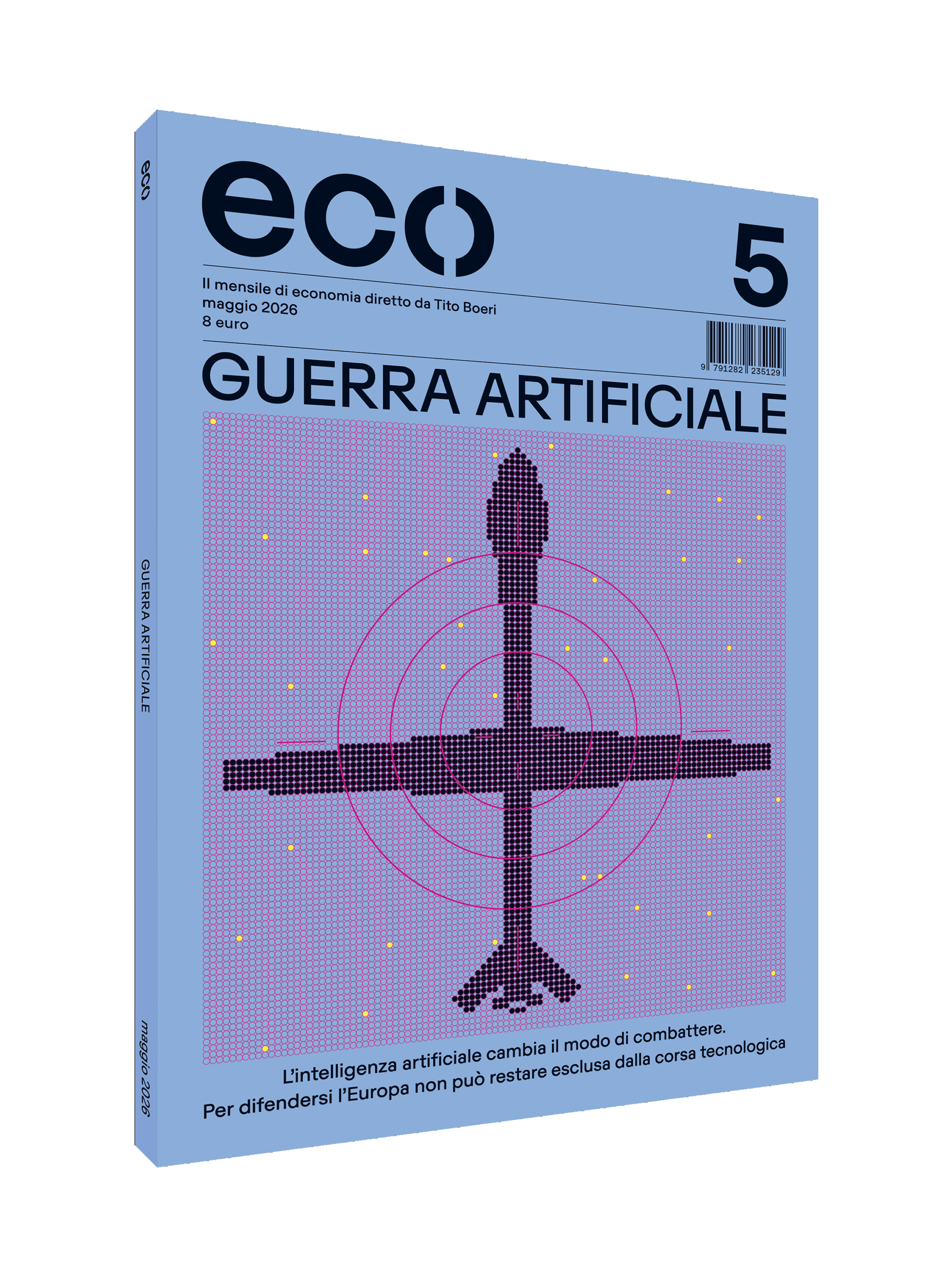
Artificial intelligence has already revolutionized the way wars are fought—and we are only at the beginning. In an increasingly disorderly and conflict-ridden world, no country can afford to forgo military AI. Whether it evolves into a force that strengthens those who defend rather than those who attack, becoming a genuine deterrent to aggression, will depend above all on how quickly societies adopt these new technologies. Europe therefore cannot afford to remain on the sidelines. It must build upon the experience gained on the battlefield in Ukraine. AI has the potential to reduce the need for military personnel in defence, yet Italy appears not to have grasped this reality. Its military spending remains heavily skewed toward personnel rather than equipment.
Artificial intelligence has already transformed the conduct of warfare, and many of its applications to the defence industry have yet to be discovered. Conflict has progressively become digital: cyberattacks, drones, autonomous weapons, and algorithmic systems supporting battlefield decision-making. Many other AI applications operate behind the front lines, as recounted in this issue of eco by those who have witnessed firsthand, in Ukraine, this new way of waging war. Modern conflicts are increasingly data-intensive and progressively less dependent on soldiers, with all the advantages, disadvantages, and ethical dilemmas that this evolution entails. Lives may be saved, but the threshold for initiating conflict may also be lowered, while those responsible for launching wars risk becoming increasingly detached from their consequences.
New Players
Digitalization has brought with it an entirely new category of actors: the major technology platforms.
Amazon and Microsoft manage virtually all the data belonging to the Ukrainian public administration and armed forces. Palantir develops the AI systems used by Ukrainian special forces for operations behind enemy lines. Alphabet, Amazon, and Microsoft provide surveillance and targeting technologies to the Israeli armed forces. Anthropic, meanwhile, has seen its systems employed during the U.S. military operation against Iran. Increasingly, strategic targets are no longer military headquarters but rather the large data-processing centres that sustain modern warfare. As we document in this issue, between 2013 and 2024 the American Big Tech companies received contracts worth hundreds of billions of dollars from the Pentagon, the CIA, and the NSA—from Amazon’s $600 million cloud-computing contract with the CIA in 2013, to Microsoft’s $19.8 billion contract in 2023 for advanced military simulations, and most recently to the $22 million awarded for the cloud infrastructure of the U.S. Special Operations Command.
Artificial intelligence is changing not only how wars are fought, but also who—or what—fights them. It is now the chief executives of the major technology companies, even before military hierarchies, who must confront the ethical and geopolitical dilemmas raised by AI in modern warfare. This is especially true because, unlike in the past—consider the case of the internet—technological transfer now appears to run from civilian applications to military ones. Image-recognition systems originally developed for Amazon’s recommendation engines end up guiding drones. Large language models designed for customer service become tools for intelligence analysis and target selection. The Defense Innovation Unit (DIU), established in 2015 in Mountain View—at the heart of Silicon Valley—and led by Apple’s former Vice President, stands as the institutional symbol of this new ecosystem.
Does AI Benefit Attackers or Defenders More?
In the increasingly disorderly and conflict-ridden world described in the previous issue of eco, we would like artificial intelligence to favour defenders rather than aggressors, because it has the potential to become a powerful deterrent against those contemplating military aggression.
Unfortunately, artificial intelligence greatly enhances offensive capabilities by enabling much faster target selection and the analysis of enormous quantities of information about the enemy. Image-recognition algorithms, drone-data processing, and pattern-identification systems make it possible to locate targets with a speed and precision that no human operator could ever match. The campaign against Iran offers the latest demonstration: roughly one thousand targets were identified and prioritized within just a few hours. Whoever strikes first knows exactly where to aim, while those under attack often have no time to conceal themselves. If you can find your adversary, you can destroy them, advance along the front, or even hope to overthrow hostile governments and dictatorships.
Yet the final word has by no means been spoken. AI algorithms are just as capable of confusing the enemy as they are of identifying it. The very systems that process and interpret massive streams of data can also generate misleading information: false radio signals, robotic decoys, artificial sounds, and deceptive transmissions. Artificial intelligence can thicken the fog of war just as easily as it can dispel it. If defensive tactics based on concealment and deception are able to keep pace with offensive innovations, the balance may ultimately shift in favour of defenders rather than attackers.
The advantage AI confers upon either aggressors or defenders may therefore depend less on the technology itself than on the speed with which different actors are able to adopt and adapt it. It is, above all, a race against time. Unfortunately, offensive states are often authoritarian regimes capable of deploying innovative technologies more rapidly than the institutions and firms of democratic countries, which are constrained by regulatory and organizational barriers. Whether AI ultimately strengthens offence or defence is therefore not merely a technological question; it is also an institutional one. Whoever governs the deployment of artificial intelligence—with what rules, at what speed, and with what capacity for auditing and oversight—will largely determine where the balance between attack and defence ultimately lies.
Consider the case of Claude Mythos, discussed extensively in the pages that follow. This AI system is capable of identifying software vulnerabilities with unprecedented effectiveness, yet Anthropic has made it available only to a small number of organizations for the purpose of testing their own defences. In the right hands, it can strengthen cybersecurity; in the wrong hands, it could become a devastating offensive weapon. The decision not to release it publicly reflects precisely this fundamental ambiguity and the race against time in adopting emerging technologies.
Who Decides—Humans or Algorithms?
For millennia, war has required human bodies: soldiers who march, fight, endure, and die. Artificial intelligence—combined with robotics and autonomous systems—promises to change that equation radically.
The advantages of autonomous systems over human operators are numerous and far from trivial. First and foremost is their information-processing capability. A soldier struggles to draw meaningful conclusions from a single satellite image of a battlefield, whereas an AI algorithm can effortlessly analyse millions of hours of drone footage. These systems detect patterns that human beings overlook, interpret enemy activity, and identify threats and opportunities at a speed unimaginable for any flesh-and-blood operator. Second is their ability to manage large-scale networks. Operations involving multiple units—infantry divisions, bomber formations, or drone swarms—have always been constrained by the human capacity to coordinate actions. Artificial intelligence dramatically expands both the scale and the complexity of such operations by transmitting and processing vast quantities of information in real time. Third—and perhaps most important from a strategic perspective—autonomous systems are capable of operating without continuous communication with command centres. This makes them resilient to electronic warfare and jamming: even when isolated by the enemy, they can continue to fight. For a modern military, whose effectiveness depends heavily on digital communications, operational autonomy represents an enormous advantage.
The reality of the battlefield confirms these theoretical trends. The war in Ukraine has witnessed an unprecedented acceleration in the use of drones—relatively inexpensive weapons that can be mass-produced and are increasingly guided by algorithms equipped with autonomous targeting capabilities. Companies such as Anduril in the United States and Helsing in Germany focus specifically on developing low-cost, mass-producible unmanned weapons. The concept of “affordable mass precision” is perhaps the most important for understanding the direction in which warfare is evolving. Artificial intelligence is making possible systems that are simultaneously inexpensive, scalable, and sufficiently accurate. The war in Iran illustrated this point with brutal clarity: American Patriot interceptors, each costing several million dollars, are being used to destroy Iranian Shahed drones worth only a few tens of thousands of dollars. Such an imbalance is unsustainable in the long run, and advances in artificial intelligence are likely to make low-cost systems even more effective.
The most significant questions, however, concern not the physical replacement of human beings but the replacement of human decision-making. How can we control and supervise the algorithms that select targets? What are the risks of relieving those responsible for military operations of their accountability? What dangers arise from an uncontrolled—almost automatic—escalation of conflict? The use of artificial intelligence has exponentially increased the number of military actions carried out automatically or on the recommendation of algorithmic systems. This raises profound ethical questions about responsibility for acts of war. If an algorithm selects a target and an autonomous drone destroys it, who is accountable for the consequences? Automated systems that respond to perceived threats within fractions of a second, without the filter of human judgment, may drive conflicts toward scenarios that no human decision-maker would ever have deliberately chosen. In principle, responsibility for the decisions and actions of algorithms remains with human beings. It is not artificial intelligence that bears legal or moral responsibility for the damage caused, but rather those who design, develop, or employ it—provided they can be identified. This is especially difficult in cyber warfare, a domain of conflict which, unlike traditional battlefields, has no front lines, no operating hours, no truces, and no ceasefires.
What Can Europe Do?
For all the reasons outlined above, Europe cannot afford to withdraw from the race for military artificial intelligence. From the perspective of digital infrastructure, Europe remains heavily dependent on the American Big Tech companies: Microsoft and Amazon manage a large share of European public-sector data, including highly sensitive infrastructure. The AI market itself is dominated by American and Chinese firms; Europe’s most valuable AI company, Mistral, is worth only a fraction of its leading U.S. competitors.
Many European countries are increasing defence spending in line with NATO commitments calling for expenditure of up to 5 percent of GDP by 2035. They are certainly not doing so for economic reasons. European countries purchase the overwhelming majority of their military equipment abroad: roughly three-quarters of spending on defence equipment translates into imports, primarily from the United States. This means that the current surge in defence spending largely benefits the American defence industry, while generating only a very limited multiplier effect for Europe’s own economy. Moreover, as we document in this issue, within three years of a major expansion in military expenditure, the public deficit increases on average by around 2.6 percentage points of GDP, while the public debt-to-GDP ratio rises by approximately 7 percentage points. And when defence spending is financed primarily through budget reallocations rather than new borrowing, governments face a stark choice between military expenditure and social spending on healthcare, education, and social protection.
For all these reasons, it is essential to spend wisely in order to spend as little as possible. A coordinated increase in defence spending—through joint procurement, integrated production chains, and standardized systems—can reduce the leakage associated with imports, generate economies of scale, and improve the efficiency of public expenditure. Recent initiatives such as Security Action for Europe (SAFE) move in the right direction, but they require sustained political commitment and effective implementation. Equally essential is the establishment of public capabilities for testing and auditing AI systems. The fact that, so far, only the United Kingdom’s AI Security Institute has published a structured assessment of the cyber capabilities of a system such as Mythos is an alarming signal.
In many European countries, including Italy, compulsory military service is deeply unpopular, while the number of young people continues to decline. As we have seen, autonomous weapons and AI systems could compensate for shrinking human resources, making defensive capabilities possible that Europe’s demographic trends would otherwise render increasingly difficult to sustain. Countries such as Italy, which continue to devote the largest share of their military expenditure to personnel—as illustrated in this issue’s chart of the month—risk finding themselves wholly unprepared for the new wars now unfolding close to their borders.
P.S. The next issue of eco, available on newsstands from 20 June, will be devoted to the economics of China.