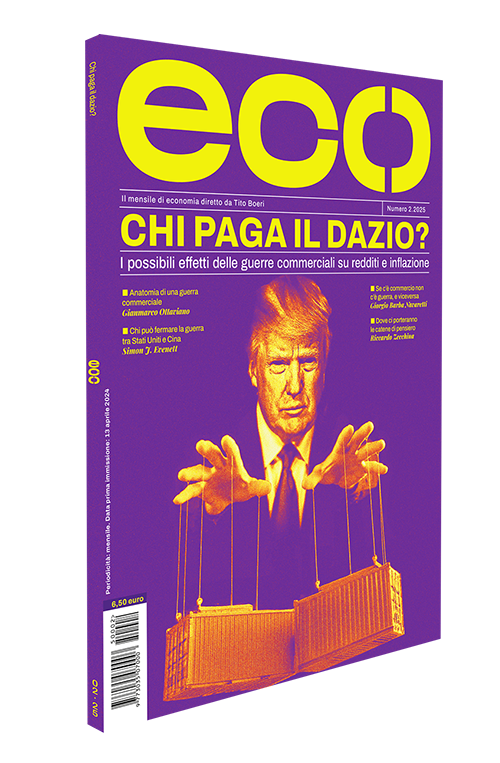
In his second term, Donald Trump acts with the belief that he has no limits. In fact, he faces fewer constraints than during his previous presidency. No one dares to contradict him, and even the well-known checks and balances of the American system appear weakened. The damage caused by his trade policies will be substantial and will affect everyone because, in tariff wars, there are only losers. Europe has the opportunity to enforce moderation and rules. The challenge is to speak with one voice, without relying on presumed special friendships.
Anyone who deluded themselves into thinking that Donald Trump’s second term would be marked by greater moderation compared to the four years of his previous presidency had to quickly reconsider. Trump II is much more aggressive than Trump I.
A Trump Without Limits
First and foremost, the U.S. president now acts instead of merely threatening to do so. During the period between the two presidencies, he had ample time to build his own leadership team, whereas in his first term, he had to rely mostly on the pre-existing elite—feeling betrayed whenever this elite, starting with Mike Pence, advised him to show restraint. Today, none of his closest associates dare to contradict him, as can be seen from the acrobatics of Marco Rubio, the Secretary of State, regarding the cuts Trump has made to development aid.
Moreover, unlike in the past, Trump II benefits from a far more compliant judicial system, having personally changed its leadership during his first term. He also operates in a world more fragmented than during Trump I: a world with more wars, with increasingly opposing blocs not only on a geopolitical level but also in terms of economic integration and trade. This allows him to face fewer counterweights within his own bloc. It is no coincidence that the first protectionist measures have been directed at countries traditionally allied with the U.S., such as Canada and Mexico, with which the United States had maintained free trade agreements—first under NAFTA (North American Free Trade Agreement), then under USMCA (United States-Mexico-Canada Agreement), which he himself negotiated and is now effectively abandoning.
The strategy is to find the path of least resistance: the tariffs imposed on Canada and Mexico—which were then temporarily suspended in response to negative market reactions—are 25%, while those on China are “only” 10%, although they are in addition to the tariffs, averaging 19%, imposed on two-thirds of Chinese imports in 2020.
Trump II also faces even weaker and more powerless multilateral organizations than during his first presidency. Consider, for instance, the resigned silence with which they have accompanied his initial moves, from the rejection of the Paris climate agreements to the withdrawal from the World Health Organization. The lack of reaction from the World Trade Organization and the Bretton Woods institutions—the International Monetary Fund and the World Bank—toward the trade wars he is unleashing is striking. It seems that they remain silent because they fear for their own survival. They have adopted the opossum’s communication strategy: better to play dead for a while than to die for real.
After all, Trump has only four years to act—perhaps just two if he makes a mess before the midterm elections.
Mercantilism in Power
Donald Trump is taking us back to the economic policy concepts of the 16th century. He has a mercantilist view of the world: the strength of a nation would depend on the trade surplus (exports exceeding imports) it can achieve against other countries.
A nation that has a trade surplus with the United States is seen as the winner of some kind of arm-wrestling match with American businesses, a nation that is “stealing” money from the United States. In reality, quite the opposite is true. A country like the United States, which maintains a trade deficit over time, is a country that manages to find investors willing to finance it. And the funds received—exceeding what it collects by selling its products to other states—can be used to finance investments that would otherwise be beyond its reach. If well-directed, these investments can increase its productive capacity and national income growth rate, improving the well-being of its citizens.
Trump also has a limited view of global interdependencies. This is concerning because it means that his policies can cause far more damage than he himself imagines. Consider the consequences of the tariffs imposed on Canada and Mexico. They could severely harm the American automotive industry because a large portion of the components it needs comes from those two countries.
It appears that even Trump himself is unaware of the effects of his decisions, which will primarily harm the three major Detroit-based automakers (General Motors, Stellantis, and Ford) in one of the swing states that helped him win the presidential election.
Another interpretation is that he is aware but, since he can no longer run for re-election, he does not fear a potential loss of popularity in Michigan. Meanwhile, his oligarchs from Big Tech are not affected by this trade war (they would be much more involved in a full-scale trade war with China).
Negative-Sum Games
In this issue of eco, we document how trade wars are never zero-sum games. There is no single winner and loser, and the gains of one party are not equal to the losses of another. Trade wars only produce losers, and the first to pay the price are the citizens of the countries that introduce indiscriminate tariffs against others, as they are forced to buy the same goods at higher prices and suffer economic growth setbacks due to increased trade barriers.
This does not mean that protectionist policies should always and universally be banned. On the contrary, in an increasingly fragmented world, protecting strategic national industries can be justified on geopolitical grounds. After all, Russia’s energy policy following its invasion of Ukraine has shown us that economic dependence is now readily used as a tool for geopolitical blackmail.
Moreover, in practice, free trade as taught in economics textbooks does not exist. International trade is regulated by the World Trade Organization, which does not prohibit protectionist measures when justified, for example, by unfair competition from countries that heavily subsidize their domestic industries to outcompete companies from other nations.
Thus, the alternative is not between trade wars and free trade but between trade wars and a regulated international trade system aimed at cooperative solutions. Just as trade wars have negative sums, multilateral trade agreements have, in many cases, proven to have positive sums—meaning they have increased the well-being of citizens in all participating countries.
The European Response
What can Europe do in the face of the upcoming trade wars? It certainly cannot remain passive. This means, first of all, that it must not fall victim to the “divide and conquer” strategy practiced by the new U.S. administration. It is often said that, due to the friendship between Giorgia Meloni and Donald Trump, Italy might be spared from trade restrictions. However, Italy’s borders with the United States are the borders of the European Union: our country alone has no hope of influencing decisions made overseas. It lacks both the necessary tools (as trade policies are decided at the EU level) and the negotiating power to do so.
Moreover, even if—hypothetically—Italy were granted preferential treatment compared to the damages inflicted on other EU countries, it would still suffer the consequences due to its deep economic integration with the rest of the Union, particularly with Germany.
A united Europe can make itself less vulnerable in an increasingly conflict-ridden world, for example, by supporting the productive and technological capacity of its automotive industry. It can also strengthen trade integration with “connector” countries, which have partially replaced China in global value chains following the tariffs introduced by Trump I. As illustrated in this month’s chart, global value chains have shown greater resilience than expected. It is towards these “connector” countries and those not aligned in major global trade wars that Europe can turn.
For this reason, opposing the Mercosur agreement—which commits the European Union, on one side, and Argentina, Bolivia, Paraguay, and Uruguay, on the other, to reducing tariffs on over 90% of imports—would be a serious mistake (on this topic, see both Carlo Altomonte’s article and the column Sovereigns in Europe).
As we have seen, Trump II faces far fewer constraints than Trump I, making him potentially much more dangerous. This lesson is also reinforced by Italy’s experience with populist governments. We have been saved (and still are) by the strict European constraints that have imposed moderation on economic policy, preventing it from being overwhelmed by the growing polarization of political competition.
In a fragmented world, perhaps only Europe can succeed in enforcing the necessary constraints to prevent the escalation of trade wars. And to fully grasp what is at stake, we must remember that many military conflicts have originated from trade wars. In the War of 1812 between England, Canada, and the United States—triggered by the British decision to block trade between France and the U.S.—the White House was set on fire.
P.S. The next issue, available on newsstands from March 15, will focus on families, work, and gender balance.