
Sale!
2/2025
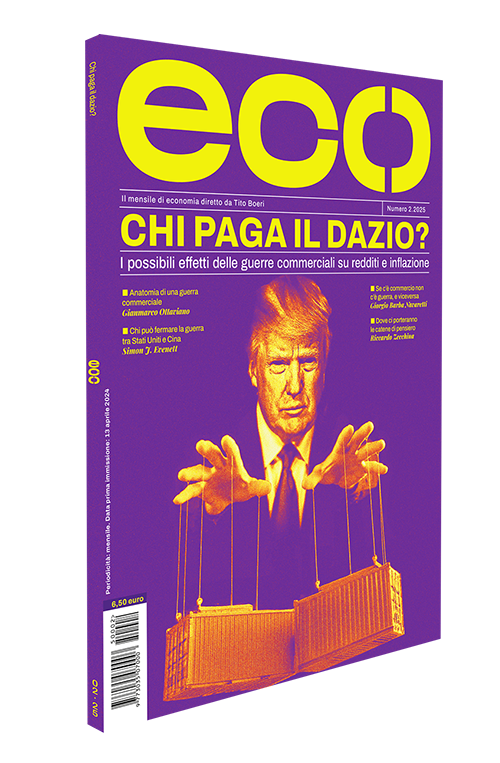
Who Will Pay for Trump’s Tariffs?
How Trade Wars Could Impact Income and Inflation
Trump’s second presidency is shaping up to be even more aggressive than the first, with no restraints. His trade policies are driven by a mercantilist view of the economy, a narrow understanding of global interdependencies, and the interests of Big Tech. Will tariffs be used as a mere bargaining chip, or will they be enforced indiscriminately, sparking new trade wars? How will they affect income and inflation? What should we expect in key trade conflicts – between the U.S. and China, North America, Europe, and emerging markets? And what role can the European Union play? Italy, on its own, has little influence.
Related products
-
Sale!
Home Has Become a Mirage
Original price was: 6,50 €.4,90 €Current price is: 4,90 €. With soaring prices in major cities and no real housing policy, home has become the new symbol of inequality In Italy, having a home remains a universal aspiration, yet the state invests far too little to address the housing emergency. Fear of appearing to help immigrants or municipalities run by “opposing” political coalitions has stalled any meaningful action. The housing plan announced by Giorgia Meloni will only work if it truly delivers affordable student housing and public units—projects that have been stalled since the old Fanfani plan. Housing is fundamentally an issue of equality, mobility, and social cohesion. And it needs to be treated as such.Select options This product has multiple variants. The options may be chosen on the product page
 -
Sale!
Against Women
Original price was: 6,50 €.4,90 €Current price is: 4,90 €. Tackling Gender Discrimination at Work and at Home Discrimination still runs deep in many areas of our society. It’s unfair, it weakens social cohesion, and it robs us of valuable human potential – something we can hardly afford as advanced countries face demographic decline. Women, along with ethnic and religious minorities and people who don’t conform to mainstream standards of sexuality or appearance, are often the primary targets. This issue focuses on the discrimination faced by women, who have become the main victims of the backlash against inclusion policies, particularly those pushed back overseas. Maybe affirmative action – like gender quotas – has sometimes gone too far. But that doesn’t mean we should undo decades of progress in civil rights. So how do we push back against this rollback and keep moving forward in the fight for gender equality?Select options This product has multiple variants. The options may be chosen on the product page
 -
Sale!
A World in Disorder
Original price was: 6,50 €.4,90 €Current price is: 4,90 €. In the vacuum left by the United States, Europe can lead an alliance of middle powers Like all populists, Trump knows how to destroy, not how to rebuild. In just fifteen months, he has driven a wedge between the United States and its longtime allies, sparked new conflicts, dismantled the international order, and weakened American democracy. To avoid ending up on the “imperial menu” invoked by the Canadian prime minister at Davos, middle powers must forge new balances and new forms of global cooperation in managing shared resources and conflicts. Europe is the natural candidate to lead this effort. As a successful model of genuine multilateralism, it has already demonstrated its capacity for coordinated action. At a time when external security has once again become a central concern, Europe’s social welfare model can also prove to be a strategic asset.Select options This product has multiple variants. The options may be chosen on the product page
 -
Sale!
Irresponsible Capitalism
Original price was: 6,50 €.4,90 €Current price is: 4,90 €. Why companies are retreating from environmental and inclusion commitments – and how to revive their engagement In just four years, ESG – the idea of renewing capitalism by asking companies to take responsibility for environmental, social, and ethical issues alongside shareholder interests – has fallen out of fashion. Major missteps have fueled the pushback from the current U.S. administration, but the underlying reasons for ESG remain unchanged, from global warming to the poor ethical standards of many corporations. In this issue, we offer several ideas for rebuilding environmental and social commitment on stronger foundations and for increasing transparency around how companies generate their profits.Select options This product has multiple variants. The options may be chosen on the product page
