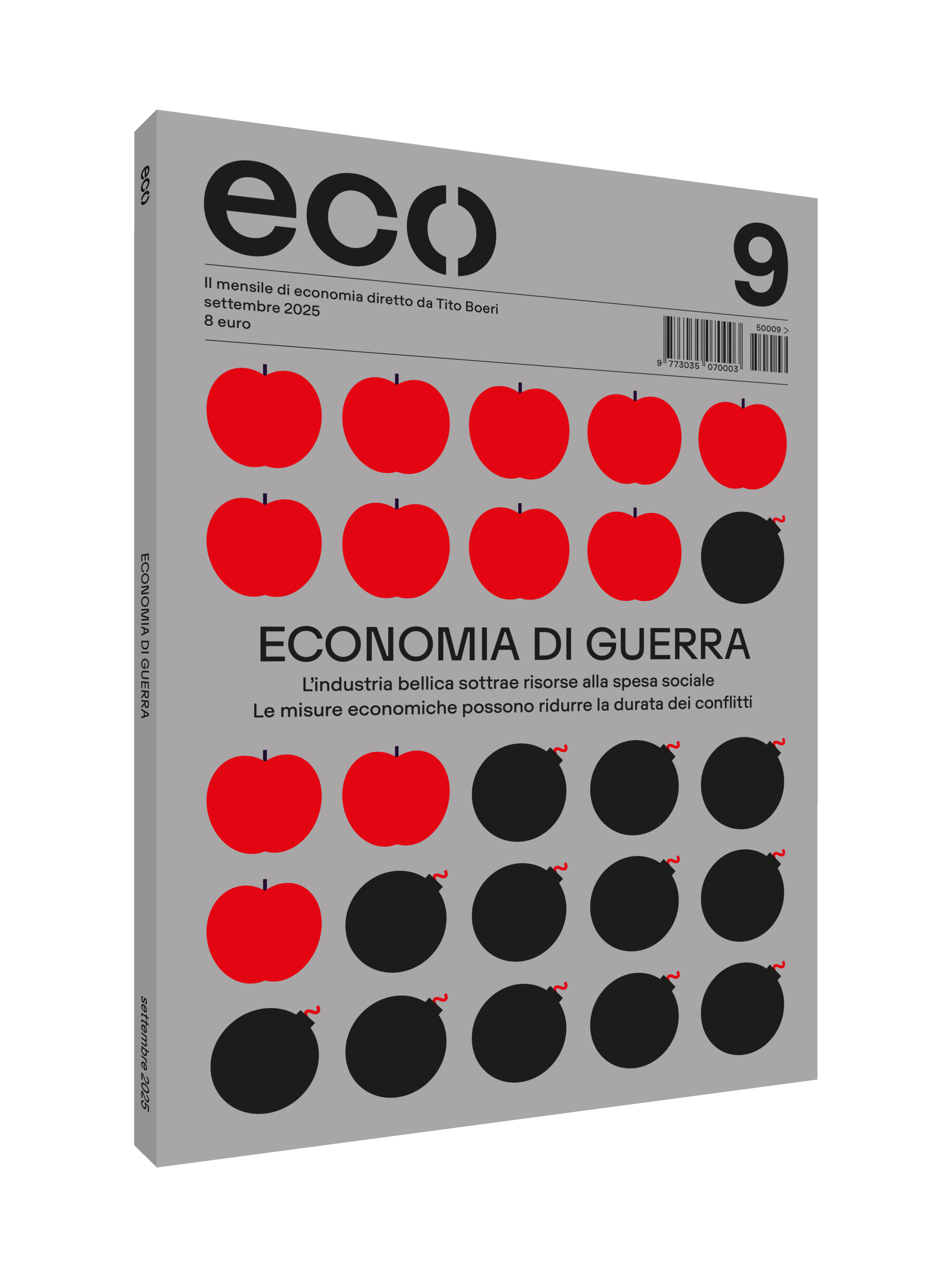
Donald Trump aspires to the Nobel Peace Prize, but so far his actions have helped worsen conflicts, from Ukraine to the Gaza Strip and the West Bank. What can be done to limit the duration of wars? Economic sanctions can hinder the import of weapons and military materials. It is also necessary to discourage Putin’s cynical recruitment of Russian soldiers to send to slaughter. A clear message the West could send is this: the doors remain closed to dictators and oligarchs, but they open to the populations seeking to flee those regimes, to escape the blackmail of money offered in exchange for being sent to the front.
Donald Trump is doing everything he can to earn the Nobel for War. In just the past few weeks, he has miraculously managed a double achievement: on the one hand, he has freed Vladimir Putin from international isolation, welcoming him as a hero in Alaska. On the other, with his tariffs, he has succeeded in reuniting a bloc hostile to Western democracies, pushing India toward the Chinese orbit. All this risks not only prolonging the conflict in Ukraine, but also opening new war scenarios in the East, with the repeatedly threatened “reunification”—read: annexation—of Taiwan by China. Not to mention the endorsement Trump offered to the Gaza Reconstitution, Economic Acceleration and Transformation Trust project on the Gaza Riviera, which has legitimized Israeli settlers and the military dictatorship established in Israel to continue massacring the civilian population in the Strip and occupying new Palestinian territories in the West Bank.
It is therefore pointless to harbor great illusions. For many years we are destined to face wars—or at least threatening, warmongering dictatorships—at our doorstep. We must confront this reality: on humanitarian, geopolitical, and military grounds. And also on economic grounds, which is the focus of this issue of eco.
What does it mean for an economy to be at war? And what does it mean for us to live with conflicts on our borders? And how effective can economic sanctions be in containing the duration of conflicts?
The Economy of a Country at War
Warfare with conventional weapons does not affect the territory of warring countries uniformly. In Ukraine, the front is concentrated in a relatively limited part of the country. In these areas there have been heavy civilian casualties, mass exoduses of people and businesses, cities almost razed to the ground, and devastated infrastructure. Here, as well as in the areas occupied by the Russians, a labor market effectively no longer exists. In the Donetsk region, largely controlled by the Russians, there are no longer any jobs offered by businesses. Major industrial plants have been destroyed and not rebuilt, or they lack access to materials essential for production; they cannot, for example, receive iron from regions under Ukrainian jurisdiction. The production chain is blocked both downstream and upstream, mines are closed, and Ukrainian-owned companies remaining in the area are unable to operate. Job postings cannot be found in these oblasts, neither on Ukrainian platforms nor on Russian ones. Among the few remaining people, many have lost their jobs, and those who want to start or resume working have no vacancies to apply for.
But the economic costs of wars go far beyond the material destruction caused by bombings at the front. Historical experience suggests that the major, longer-lasting costs are linked to the loss of human capital and entire generations of businesses that can no longer be founded or are forced to shut down even if they have not been bombed. These costs are felt even hundreds of kilometers from the front: companies that have lost suppliers located in occupied or mined zones; employers at all levels complaining of staff shortages because people have been drafted or fled abroad to avoid conscription. Private companies cannot fill vacancies, and this is currently Ukraine’s number one problem—much more than the frequent interruptions caused by air raid alarms.
An economy at war becomes an economy with a much more prominent role for the state, not only because a significant part of the working population is drafted and paid by the government through central bank money creation. The fact is that resources move from sectors that produce consumer goods and provide services to households and firms toward the military industry and its production chain. It will be very difficult to reverse this process once the war ends. Countries at war struggle to keep their school systems functioning due to the exodus of teachers, even before the physical destruction of schools. Generations of young people do not receive an adequate education, and those who were more educated to begin with leave the country at the onset of the conflict.
The Costs for Those Near Wars
Now let us consider the costs for those who, like us, must coexist with wars at their doorstep. The rise in military spending imposed by geopolitical risk comes with a heavy bill. “Every gun that is made is a theft,” as General Dwight Eisenhower himself acknowledged, because it diverts money from schools, social assistance, and health care. Certainly, any additional public expenditure, including military spending, has expansionary effects. But there are countless other ways to spend public resources that stimulate the economy just as effectively and are more desirable than military spending: purchasing hospital equipment, maintaining roads, increasing teachers’ salaries, or boosting support for indigent families.
This is especially true in Europe, whose strength historically lies in its social protection systems. Now the Old Continent will have to buy weaponry, mainly from the United States. Military spending could have long-lasting expansionary effects on the economy, particularly if oriented toward the domestic market and capable of generating positive spillovers for innovation in private firms. But this does not seem to be the case in Europe, which is not known for its military technology—except perhaps in a few niche products.
Economics and the Duration of Conflicts
Many conventional wars are not blitzkrieg, lightning wars. They last long and are won through the resilience of economies more than through weapons—in businesses more than in trenches. The war effort requires massive investments in machinery and large armies. Robots and drones do not fully replace military personnel. And not all countries are able to recruit people to send to the front over the long run.
Economic sanctions aim to limit military capacity in terms of machinery. They reduce imports more than exports of the targeted country. This is the same principle followed by the Allies in the world wars, when they imposed a naval blockade on Germany. The main goal was to prevent it from importing, not exporting. In fact, if we look at today, Russian imports have indeed decreased considerably in recent years, especially in the technological sector, which is crucial for the arms industry. It is possible that Moscow’s major military inefficiencies are related, at least in part, to difficulties in importing and replacing materials.
Of course, the problem with sanctions is that they must be applied by everyone. Until recently, even countries that did not formally adhere to them, including China, had reduced exports to Russia. This is no longer the case: the Russians have managed to import more drones from Iran, ammunition from North Korea, and microchips from China. And the axis being formed—thanks also to Trump—between Russia, China, India, and other countries makes sanctions less effective.
New measures of this kind against Russia should undermine its ability to recruit people for the army. This is not easy, because it is an economically small country (its GDP is equivalent to that of the Benelux) but with a large reservoir of desperate people to draw from. And Putin is cynically doing so to the fullest. Every day, nearly a thousand Russian soldiers are killed or severely wounded. Since February 2022, the dead are estimated to exceed 250,000—five times the casualties in all wars Russia has been involved in from World War II to the present, nearly twenty times the deaths in Afghanistan or Chechnya. The Russian army needs to recruit about 30,000 soldiers per month to offset losses and injuries. These people are not recruited in Moscow or Saint Petersburg, but in the northern territories or the far eastern regions, by offering them very generous compensation relative to local living standards. The sign-up bonus for a soldier can reach $30,000—one hundred times the monthly wage in many areas. Soldiers’ salaries exceed $2,000, seven times the average wage. Families of the fallen are not only offered medals and honors, but money—large sums relative to the local standard of living. Compensation can reach up to $150,000 per family member killed at the front, much more than they would have earned in an entire lifetime of work. It is no coincidence that these regions are seeing an increasing number of new bank accounts opened.
But the reservoir of desperate people is not unlimited. Russia too suffers from demographic decline, and in an increasing number of age groups there are more women than men. It is no coincidence that the compensation given to soldiers and their families has increased sharply as the conflict has dragged on. It is unlikely that recruitment rates of this magnitude can be sustained over time. We must in every possible way hinder the cynical purchase of human lives by dictators like Putin. The West can offer the populations of these regions far better prospects than compensation—no matter how apparently generous—for the loss of their loved ones. For example, residence permits can be offered, or twinning programs can be established that invite young people from these areas to learn trades and earn money in much more prosperous parts of the world, which also desperately need labor.
Instead of welcoming Putin with full honors, why not extend to young people from Kamchatka the generous incentives (about €2,250 per month) granted to U.S. citizens to encourage them to reside in Alaska? Difficult, but not impossible in the age of social media, to convey to the affected populations the message that free countries will open their doors to them, while closing them to oligarchs. They should not feel abandoned to a grim fate as producers of human lives for a front thousands of kilometers away.
P.S. The next issue (on newsstands October 18) will be dedicated to housing.