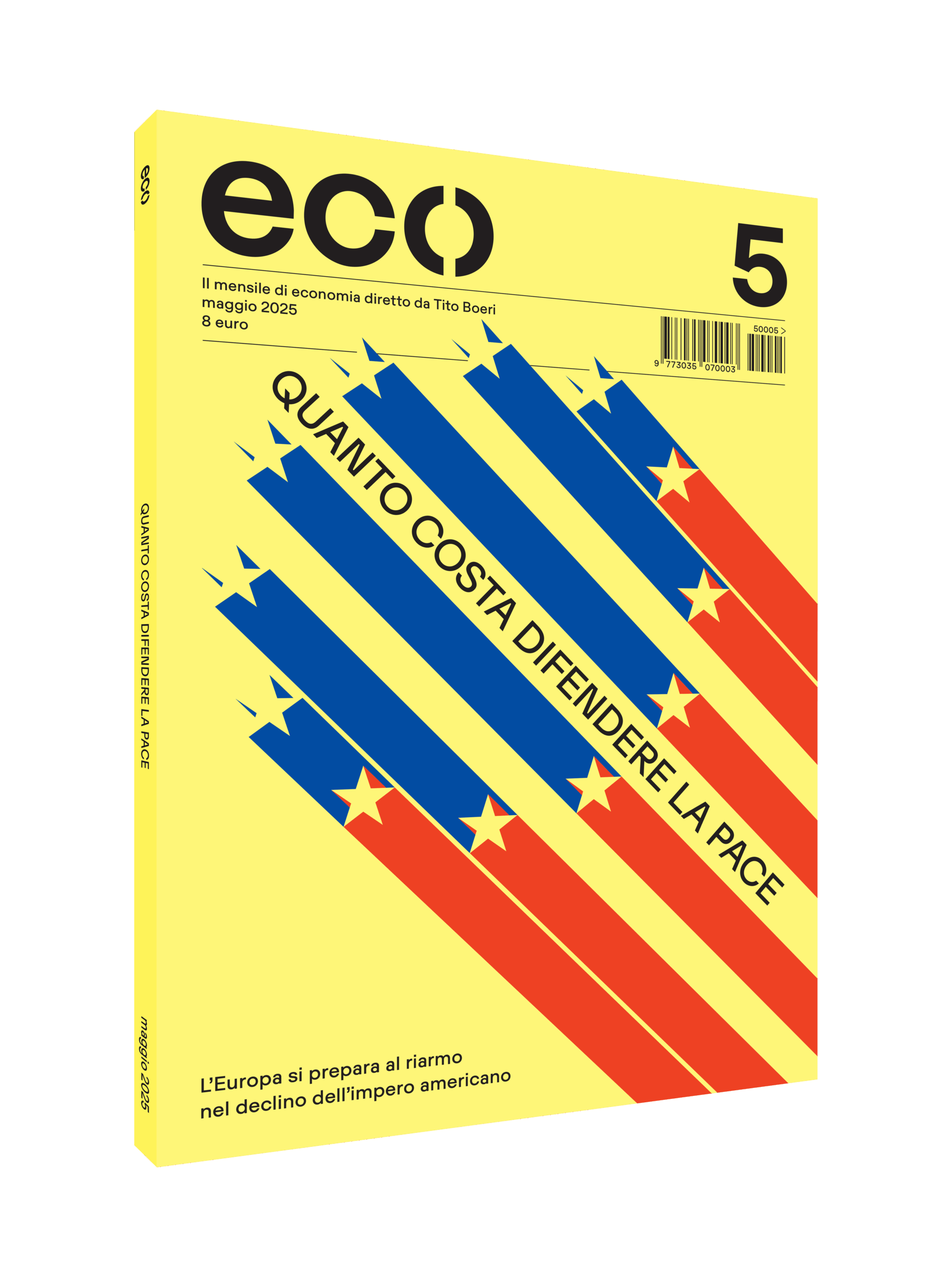
In an increasingly fragmented and unstable international scenario, greater investments in European defense appear inevitable. Equally inevitable are their consequences: increased defense spending means fewer resources available for civilian use. It is therefore advisable to avoid waste and duplication, relying on a single European command rather than allowing each EU member state to raise its own military budget. With wars becoming longer—due to technological innovations that favor defenders over attackers—a healthy economy becomes a winning weapon.
Today, as European citizens, we feel more vulnerable and defenseless than ever. We are anguished by the seemingly endless war on our eastern borders and, looking further south, we see a Middle East in flames, with thousands of civilian casualties, while we receive people fleeing from 53 other conflicts scattered across the globe. We watch helplessly as the American empire—still the world’s greatest military power—declines, growing increasingly hostile and confrontational toward its traditional allies, abdicating its role as global guardian. Since Russia’s invasion of Ukraine, we have realized that economic sanctions are becoming less effective: they have not curbed Putin’s bloodthirsty ambitions. Even the most powerful economic pressure tool today—access to the international payments system—proves far more fragile than expected. Many emerging countries are developing their own payment systems and financial services, which in itself reduces the influence of actors like the United States and Europe, who currently hold a monopoly.
Europe, therefore, no longer seems to have a choice: it must learn to defend itself—militarily, and more than in the past. No one knows exactly how much this will cost. According to the European Commission’s rearmament plan, approximately €800 billion will be needed by 2030. This is a staggering figure, €100 billion more than the amount allocated to Next Generation EU. Let us not forget that those funds were intended to support the recovery and resilience of the European economy after the devastating Covid pandemic. Now the aim is to spend even more—and solely for the military industry. Let us hope that, at the very least, this time the decision about how much to spend was not made before determining how to spend it. In any case, if this is the path we must take, where will we find the resources to do so? What other expenditures must we give up?
More Weapons or More Social Spending?
Let’s clear up some wishful thinking. Many politicians and prominent commentators have suddenly embraced the cause of military spending. In doing so, they argue that it is “good” spending, that it boosts GDP and stimulates the economy. According to them, there is no trade-off—no conflict between military and civilian spending, no choice between funding missiles or funding social services, as discussed in the very first lessons of economics. That resource constraint which once led Dwight Eisenhower—general and U.S. president—to declare that “every gun that is made is a theft” because it takes money away from schools, social assistance, and health care.
The reasons why military spending supposedly no longer comes at the expense of civilian spending are not always clear. Broadly speaking, some argue that it drives technological spillovers and stimulates GDP from the supply side, while others claim that purchasing weapons and expanding armies boosts demand. And, of course, some say both effects are at play.
The theory of technological spillovers from defense spending has a long tradition, but so far lacks empirical confirmation. Proponents cite a handful of anecdotes—such as Pentagon contracts allegedly being behind nearly all major innovations in recent decades, from the internet to the iPhone. Let’s suppose that military procurement in countries like the U.S. and Israel has indeed had some spillover effects on civilian technologies, even if difficult to quantify. But Europe is not Israel. Europe is not known for its military technology, except perhaps in some niche products. Even if it were to spend half a percentage point more of GDP annually on defense—a huge amount—it is unrealistic to expect that this would suddenly become a technological engine for the entire civilian economy. There might be some incidental spillovers, here and there, but if the goal is technological progress in the civilian sector, it’s far better to invest directly in R&D rather than hoping for modest and uncertain trickle-down effects from the military sector.
The second rationale for increased defense spending is also unconvincing. Larger purchases of military equipment and expanded enlistment are certainly increases in public spending. But so are purchases of hospital equipment, road maintenance, higher teacher salaries, or larger welfare payments to impoverished families. The list could go on. If the justification for increased military spending is its expansionary effect, there are countless other alternatives with similar effects—many of them arguably more desirable. Especially given that the econometric evidence on the expansionary effects of defense spending is not particularly favorable.
How to Minimize the Cost of Defense
We must accept that, for understandable reasons, we now need to spend more on defense than in the past. But this must necessarily come at the expense of civilian spending. When investing in the military sector, it is therefore essential to be as efficient as possible—to achieve our objectives with the least possible use of public resources.
Fortunately, there are ways to spend better in the military field—many savings are possible. This May issue of eco dedicates several articles to the topic.
A general principle above all: we need a single command. Defenders need centralized command much more than attackers do. It is unthinkable to be efficient in repelling potential aggression with 27 states in command. If some EU member states are not willing to manage defense at the community level—and let us hope Italy is not among them—those who are ready to coordinate should move forward on their own. Duplications are not only expensive, but also militarily harmful. They allow a potential enemy to carefully choose their target. The reaction of the attacked party’s allies—positioned along the path of least resistance—will always be too late.
Efficiency also means leveraging the experience of those who have spent more on defense in recent years. As we show in this issue’s “Chart of the Month,” the countries closest to Russia’s border have invested the most in defense. Ukraine, for obvious reasons, has done more than anyone—developing a relatively efficient arms industry. It has benefited from the fact that recent technological advances have tended to favor defenders over attackers. Drones, for example, make surprise attacks much harder and prevent concentrations of offensive forces. Why not help Kyiv further improve the efficiency of its military industry? This would achieve a dual outcome: supporting the Ukrainian people in resisting Russian invasion today, and enabling Europe to secure lower-cost military supplies in the future—without relying on potentially hostile suppliers.
Savings are also possible in how this spending is financed. Instead of allowing individual EU countries to bypass European fiscal rules to increase military spending—encouraging them to manage rearmament nationally—it would be better to raise funds at the EU level (perhaps using proceeds from assets seized from Russian oligarchs) and coordinate purchases and investments. Access to cheaper debt financing could be a strong incentive for coordinating European defense. And centralized procurement can yield better terms, as Leonardo CEO Roberto Cingolani reminded us in the April issue of eco.
The Duration of Wars and the Economic Power of Nations
The fact that technological progress has recently shifted in favor of defense over offense also gives us a great advantage: we can now leverage our economic strength more than before. Europe—from Portugal to the Balkans, from the UK to the Nordic countries—accounts for more than one-fifth of global GDP, has economic weight comparable to the United States, greater than China, twelve times that of Russia, and hundreds of times greater than many potentially aggressive authoritarian regimes around the world.
Technologies that favor defense over offense tend to prolong wars (consider World War I and its trench warfare, which—judging by how slowly the front line moved—has many features in common with the current battles in Donbas). When wars last longer, economic strength becomes increasingly decisive. Victory goes to those who can endure longer, and enduring requires strong, resilient economies. Economic power thus becomes more important than military power. In a world that is increasingly fragmented, strengthening our economies has become an ever more strategic factor—even for defending our borders. It’s worth keeping this in mind as we work to bolster the European economy. The next issue of eco will be dedicated to this very theme.
The Citizenship Referendum
From its first issue, eco has paid close attention to immigration issues. We believe public debate on the topic should not be monopolized by those who have built their electoral success on the fears—often irrational—of many people and on the challenges newcomers face in integrating.
The June 8–9 referendum on the citizenship law proposes repealing the current ten-year residency requirement, restoring it to five years, as was the case under Italian law before 1992 and as still provided by the legislation of many European states. Italian naturalization rules were designed for a country of emigration, not immigration, and would require more comprehensive reforms than a referendum can provide. But a “yes” victory would be very important to ensure faster economic, social, and cultural integration for those who are already here. It would also make future reforms easier—reforms that further encourage newcomers to integrate, learn our language, understand our culture, contribute to our pension system, and avoid falling into criminal networks.
Naturalization is a powerful incentive for all of this, as we once again document in the following pages. That is why we invite our readers to vote a strong “yes” in the referendum seeking to halve the residency period required of non-EU foreigners to obtain Italian citizenship.
P.S. The next issue will be on newsstands June 14 and will focus on Europe’s resurgence.